I've been wanting to express to you the time I spent in Jeon-Ju and Buan for Korean Thanksgiving for a long time, but I've been so incredibly lazy and I let my little life and world get in the way.
It was an amazing time and a great opportunity to visit another part of Korea. I was lucky enough to be invited by, my then, Korean teacher to spend time with her and her family in her home town. This brings back my first memory of being invited for Thanksgiving. It was my first year of university and I had been invited to Moncton (Canada) for what I would consider a “real” North American Thanksgiving. It was that; I’ll always have fond memories of it.
Thanksgiving in Korea is considerably different. Here’s how it went.
On the first day, we took the KTX (high speed train) to Iksan and then transferred to a regular speed train to Jeon-Ju. It was dark and raining by the time we got to Jeon-Ju. We were picked up by Son Mi’s parents who immediately took us to a restaurant. I, who hadn’t had a cold since April, was sick and getting sicker by the hour. I was hoping it would pass. We had dinner with her parents’ friends. They were celebrating a birthday. Five couples in total plus me and Son Mi. I tried Hong Oh for the first time.
Now, hong oh is skate (looks similar to sting ray, I think) that is marinated in this foul-smelling and fouler tasting ammonia-based something or other. It is basically rotten, uncooked fish prepared on purpose for this particular flavor. You eat it with a piece of pork and kimchi to make a trio. That particular trio is called “sam-hap”.
 |
| Sam Hap: fish on the bottom left |
At first, it seems okay until the taste permeates your mouth. Afterwards, you can’t get the taste out for hours. Son Mi likens it to a kind of minty flavor. I wouldn’t say that exactly, but that’s the closest description I could think of. This is probably the first thing that I actually hated. I don’t like all Korean food, but most of it, I either love, like or can tolerate. This one, I’m happy to never eat again. The main course was some kind of fish stew. Kalchi (a kind of fish) stew. It was okay. Nothing special. After dinner I really needed medicine and her parents were nice enough to help me find a pharmacy open at 9:30p.m. I immediately took the medicine and started feeling better within the hour.
All I wanted to do was go to bed, but then her mother asked us to do some work. We had to separate the heads (and therefore poop) from the bodies of I don’t know how many pounds worth of myolchi (anchovies). It started off pretty tedious, but it was cool after a while because I got the hang of it. The anchovies were dried, of course, and we were doing this in front of the TV. The movie “The Island” was on, which I had never seen. Son Mi has a much shorter attention span than I do so she quit a few times as I continued. I felt a strong sense of duty was involved because they were housing me and paying for everything (transportation included), so I carried on, as I can when I put my mind to something. We went to sleep around 12:30a.m. and had to wake up at 7:00a.m.
The next morning we got dressed and then met up with two of the couples from the night before, and their kids. We left the city to go have breakfast at a restaurant famous for their soondubu (soft tofu stew). It was really good, but too copious for me that early in the morning.
 |
| Soondoobu |
We returned to the apartment (by the way, the apartment is really extravagant and posh) and finished working on the anchovies. It felt good to finish all of them! We later went downtown to where the old buildings from centuries ago still stand. It’s the place in Korea where most of these old building (around 800) still exist in one place. It was where the aristocracy lived. We toured that area and I took lots of pictures.
 |
| Downtown Jeon-Ju |
We walked around quite a bit and though it was drizzling, we kept on the lookout for cool experiences. We found an old house that was inhabited by a rich Jeon-Ju family. It was quite ironic to find a basketball hoop peeping out over the top edge of the stone wall; a weird sign of modernity set before such a historical backdrop. I had to take a picture. Even if you embrace the past, the present creeps up nonetheless.
 |
| A basketball hoop in a traditional home |
After visiting that house, we turned up a small cobble stoned path where we encountered a cultural site. It was an area that celebrated the past of this wonderous city and one of the houses in that complex had traditional wedding hanboks we could try on. It was cool. The headdress was really heavy!
 |
| I was the bride and Son Mi, the groom |
We were also offered some green tea and my favorite Chuseok treats “songpyon”: steamed rice cake filled with sesame seeds and melted brown sugar. Delicious!
Afterwards, we kept wandering about and came upon a paper shop. Basically they make all kinds of things out of paper, including ties! What’s so amazing is that for some of these, you would think it was real fabric! Jeon-Ju is know for this particular type of paperwork. They made some beautiful pieces and I bought a few as mementos and gifts.
After noon, we met up with her parents and had lunch. We had the ever famous Jeon-ju Bibimbap and I have to say it lives up to its name. It was excellent! I wasn’t really impressed the first time I had bibimbap because the vegetables were raw and the rice was cold (this was in Seoul), so it wasn’t really impressive. This bibimbap was served hot and the veggies had been steamed. It was great!
I was later to learn the difference between regular bibimbap and dolsot bibimbap, the latter which is served hot in a special bowl that keeps the ingredients warm for a long time. I never ate regular bibimbap again. Once you go dolsot, you never go back!
 |
| Jeon-Ju Bibimbap. Yummy! |
Lunch being over, we got in the car and headed to Buan, Son Mi’s father’s hometown. There I met the extended family. Her father is the oldest of 4. Three boys and one girl, if I remember correctly. The grandmother lives with the youngest son, which is pretty rare, they usually live with the oldest son, but since he lives in Jeon-Ju, I guess she opted to stay there. The second oldest son has a mushroom farm. I didn’t meet him until the next day.
It was quite an awkward setting. The youngest son has a wife and three daughters. The two oldest (teenagers) are well versed in piano and were continuously practicing or studying. The youngest was around 7 and took taekwondo. She showed off her superior skills to us ( we were still beginners in the martial art at that time, so she knew more than we did!). They didn’t speak any English, except for the youngest son (who, regardless, pressured me to speak Korean) and the daughter (who was an English teacher and spoke quite fluently). Imagine stepping into someone’s home where you only really know one person and being introduced to 14 new people all at once. People grilling you with questions that you don’t understand, trying not to offend anyone, being helpful and dealing with a cold all at once! Oh my god! It was quite the experience.
But they were all very nice. We sat down to dinner around two low tables which couldn’t fit us all, so there was a very obvious split. The men sat down to eat first and since I was the invited guest I got to eat with them, while the women and girls waited until there was space. Here we are back to the sexist vision of who gets to eat first. The wife of the youngest son was basically the one only cooking for 14 people and I saw her cooking all afternoon and into the night with some of the other wives and children helping out from time to time. I offered my services but was politely refused. I felt bad just sitting there like a man waiting for the food to be prepared.
Anyway, after it was all over (it was very good, by the way) the tables were cleared and the games came out. There is a very popular type of gambling game that Koreans just love called "Go Stop". It’s a card game with specific drawings and designs on them that have their natural suites. But when you play, they are matched up with other designs and then you play this all with money. It was so complicated! And though they tried to explain it to me, I didn’t get it and they eventually gave up on me!
Another game was brought out instead, an old game from hundreds of years ago, played with a board and sticks. I forgot the name. Sorry! This is a very easy game to learn and lots of fun. I had found my groove and we played with the younger members of the family while the adults kept gambling. I was later (about a month later, by a student) given this game as a gift.
The next morning, we all woke up on our own (though I have to admit that the sound of the vacuum cleaner at 8am doesn’t really allow you to wake up when you want) and that’s when the women and female children of the house got down to work. We needed to prepare for the Chuseok dinner that night. It was quite the experience and I was stoked to take part and contribute to the process.
We made all kinds of fried foods dipped in a batter and fried in a special electrical pan. It was quite fun and the women were fairly helpful, though I think that they didn’t think I would be able to cook quite as well as them. I spent most of the time watching.
 |
| Fried fish and vegetables in batter |
I guess this was inevitable because earlier in the day, we made "sook songpyon", which is songpyon made with a green plant whose name I keep forgetting in English. I much prefer the white ones, but they only made the green ones. This was a complicated process. The dough was pre-made by the wife of the youngest son, so we had to take a piece and roll it into a ball and then make a hole into which we poured a small amount of sugar and sesame seeds, the mixture also pre-prepared. We were then to close them up into a crescent shape, much like a moon. The first few I did were quite horrible compared to the others but as I continued, I think I got much better. The others didn’t think so, though, and were systematically laughing at me. It hurt a bit, but I guess that’s the lot of the foreigner trying to cook Korean food. That’s life!
Later in the afternoon, after the food had pretty much been prepared, I was kind of bored. Son Mi had gone into one of the rooms and was reading comic books and had left me in the living room watching Korean TV. I felt really out of place. Around 3p.m. or so, Son Mi and her father told me that we were going to go sightseeing.
I got dressed and we set off. I didn’t know what we could possibly see in this area. It’s a small town. But I was amazed. Our first stop was at the great dam that had been built. This is, apparently, the biggest dam in the world. The idea is to make Korea bigger. So they have planned to cut off some of the ocean and turn it into land so that factories can be built in that area. It is quite a sad thing, actually. We humans have done so many crazy things to this earth, and here is yet another thing to add to it. The locals have been very much against this project, which started in the 70s, I think. They protested for years and the government stopped it for a while when they realized the consequences of such actions. In the end, however, they went through with the project because the damage had already been done and going backwards was no long worthwhile.
 |
| All the water to the right of the dam will be turned into land |
After that sad experience, the sun started to come out (it had been raining earlier in the day and the sky had been overcast) as we drove out to the beaches.
 |
| Love this picture! Unfortunately, the power lines got in the way |
The small roads were lined with delicately-colored gorgeous flowers called “gossmoss”. Some of the beaches were founded on stone and as we walked over the uneven ground, I took some interesting pictures of the wave patterns that had been carved into the stones over centuries. Tide pools were everywhere and quite a few people were enjoying the mild weather.
 |
| Sitting on the uneven ground. A man is fishing in the background |
On the sandy sections, seaweed had washed up on the shore. Large sacks were placed there and people were picking up the seaweed the ocean had discarded. This would then be used for cooking soups. It’s always amazing to see how the earth gives with such generosity and yet we go to the supermarkets and purchase these same items for astronomical prices.
 |
| Washed up seaweed |
The beaches checked off our list, we went to a movie set. When I was told about this initially, I was not at all interested in seeing it, but I was pleasantly surprised. Soap operas in Korea are a completely different affair from western-style soap operas. Over here, the most popular are shows that take place in the olden days, like during the Joseon dynasty. People are dressed in the garb of the time and the setting is in old castles. The Korean soap opera is not a sex-based affair, rather it focuses more on human life. This set had been built to look like kingdoms of that time period and I felt like I was walking into another time. It was quite cool, actually. Son Mi’s father paid for our tickets and we went inside and walked around. There is a popular show being filmed there these days, but since it was Chuseok, no one was working.
 |
| Movie set |
After we left, Son Mi’s father had one last place to show me. He had saved the best for last, in my opinion. We went to a Buddhist temple called Nae So Sa. Usually temples are up in the mountains and you have to hike to get to them, but this one is about a 10 minute walk from the road set away from any towns. It was heaven on earth. Though there were many people, we walked through a tree-lined path, dark due the canopy of trees above us and it felt like we were entered another world, which would soon be revealed to us.
 |
| View of the tree-lined path from the entrance of the temple |
When we got to the entrance of the temple, there was another, wider path lined with Japanese maples (one of my favorite trees in this world!) leading up to the gates. This temple was originally built in 633AD, but has been restored several times, usually due to wars. A fabulous tree towards the entrance is said to be 1000 years old.
 |
| 1000 year-old tree |
There was a peace there that made me want to come back on my own for a long weekend. Many of these temples in Korea offer a templestay, which is the opportunity to go and stay in a temple for the weekend. Many times, you have to be silent during those weekends. That’s no problem for me. I spend so much time alone and with my own thoughts that I don’t need to talk. The temple is surrounded by mountains and I saw pictures of it in the winter. That would be the ideal time for me to go there. Blanketed in snow, it is a silent haven.
 |
| View of the mountains from Nae So Sa Temple |
Though I have never returned to Nae So Sa Temple, I still hope to have a templestay experience in Korea before I leave. There is no downside to it.
We (I, reluctantly) returned to the apartment after that, only to go out again to the cemeteries of Son Mi’s grandmother’s parents so that they could bow to them. The sun was setting and it was getting pretty dark so the pictures I took are not perfect, but it was really interesting.
 |
| Cemetary of Son Mi's grandmother's parents |
In Korea, the burial system is unlike anything I’ve ever seen. People are not buried in coffins and then placed six-feet below ground. Instead, they are buried and then a mound is built on top of the body. In Korea, if your family has enough money, you are not buried in a communal cemetery. Instead, you purchase land on the side of a hill and bury your loved ones there. As we drove around in the countryside, you could see hundreds of mounds dotting the landscape next to fields of rice and other agricultural goods. This tradition is devoid of religion, but definitely stems from Confucianism. About 50% of Koreans have no religion, but even those who do still carry on the traditions of honoring the dead.
That night we returned to the apartment and had a large dinner. The next morning, bright and early, we set up the offerings for the Jaesa, the official act of bowing and honoring those who have passed. This Jaesa was to honor Son Mi’s grandfather. Traditionally, it is the men of the family who are responsible for doing the actual bowing etc… but the younger generations were also included in this ritual. They even included me in it! I was uncomfortable, but they were more than happy to show me how it was done. The youngest son even took a picture of me bowing. When bowing to the deceased, you must put your right hand above your left hand. When bowing to the living (such as during a wedding) you place your left hand above your right hand.
 |
| Here I am bowing in the far left |
The tables were laden with food for the spirit. Fruits were placed in little piles and the tops were cut off so that the spirits could eat them. There is a special placement for every type of food. It is so precise that the newspapers put out an article every year at this time explaining the exact placement of every food item, including a helpful picture to make it foolproof. Son Mi's family consulted the picture in the newspaper to make sure everything was perfect.
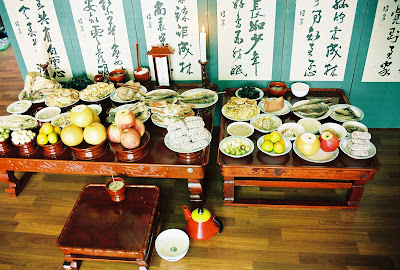 |
| Offerings for the deceased |
The theory is that in the morning you do the Jaesa in the home. At this moment, the spirit comes to the home because you have called to it. There is an elaborate tea service prepared where the men drink the tea. This knowledge is passed down generations, men to boys. Today, things are changing and some families allow women to perform this, but in Son Mi’s house, they were still pretty traditional.
Interestingly enough, it seemed as though the women were completely exempt from the bowing. They made the food and that was it. Son Mi’s grandmother didn’t even bow to her husband. It was all kind of confusing for me because I don’t understand the intricacies of the roles of men and women, but I took it at it came.
After doing Jaesa in the house, we set out to the actual burial site of Son Mi’s grandfather. It was a hot and sunny day. There were two mounds on the plot. One was surrounded by a little cement wall, the other went without. I asked who was in the other mound. I was told that it was in preparation for Son Mi’s grandmother. That’s kind of eerie. Here we are, the whole family, bowing down to the patriarch of the family with another mound just waiting for the matriarch to join in the not so distant future.
We spent some time there and the family had a little picnic with the food that had been prepared and I took pictures of many other families that were doing the same thing in plots not too far away from us. We were in the middle of fields of rice, but we were also giving our respect.
 |
| Bowing to Son Mi's grandfather |
We returned to Seoul later that afternoon and took an interminable bus ride there. It took us over 7 hours to return because of traffic (normally it takes 3 hours). And keep in mind that buses have special lanes on highways! It was crazy! All in all, a really cool experience that I will not soon forget. If you ever get to Korea, pass by Buan; a cute little town that might not say much, but take a little ride out to the coast and there are some sights that will make you smile. It was well worth it and I’ll be forever grateful to Son Mi’s really cool and wholly generous family for inviting me into their homes.
Next week I’m off to Gyeongju, the oldest town in Korea where the Shilla dynasty once had its capital. I will be traveling on my own, so I think it’s going to be a new and exciting adventure. I’ll keep you posted!


